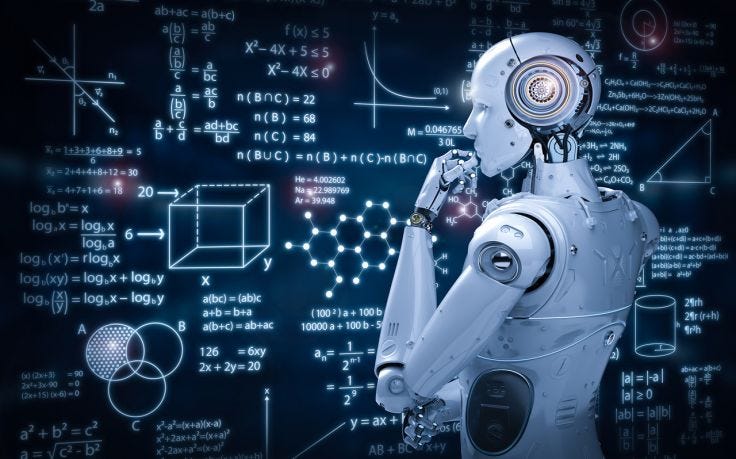

General AI, or Artificial General Intelligence (AGI), is an artificial intelligence that is capable of understanding, learning about, and applying knowledge to a range of tasks as well as any human. General AI or AGI is not limited to a specific type of task like narrow AIs are, such as facial recognition or language translation. AIs that can perform any of the intellectual tasks that a human is capable of performing are AGIs. The idea of a "thinking machine" has captivated the minds of scientists, entrepreneurs, and futurists alike, and it is an ambitious goal that we can dream about.
The prospect of devices or machines that are capable of thinking, reasoning, and making self-right decisions can lead to enthusiasm and caution. AGI holds the promise of radical breakthroughs in various fields, including medicine, space exploration, and scientific discoveries." However, AGI is full of dilemma in ethics and safety relating to it. Making sense of AGI in its simplest form can help us structure the ways we can relate to technology, both now and into the future.
Why General AI Matters
AGI could transform industries; for example, imagine a machine that does not need to be reprogrammed for every different area, provides real-time decisions, solves problems we otherwise could not solve, and is capable of optimizing complex systems. An AGI could learn and transfer knowledge from domain to domain, so if you trained an AGI to perform tasks in medical diagnostics using its learned reasoning it could just as easily assist with creating sustainable agricultural systems.
Nevertheless, creating such a system is extremely complicated. It would not only need data processing and deep learning but also reasoning, memory, and consciousness-like awareness. Existing AI systems do not have these qualities and instead use narrow algorithms that can do one thing well. AGI would need a single architecture that imitates or beats human cognition on more than one level.
To this day, there is no actual AGI system. Researchers continue to argue over what the best approach should be—should AGI be modeled on the structure of the human brain or an entirely novel computational paradigm? Regardless, the road to AGI is as much a philosophical journey as it is a technological one. It questions our conception of intelligence, consciousness, and what it means to be human.
The question isn't if intelligent machines can feel any emotions, but if machines can be intelligent without feeling any emotions.
The Path Forward
The creation of AGI needs to be approached with responsibility, caution, and international collaboration. Governments, business, and academia need to collaborate to create structures for ethical development and use. Clear objectives and risk management policies must be implemented to prevent unwanted side effects.

Education will also have an important part to play in the AGI world. As machines get smarter, human employees will need to adapt to work with wise AI systems, not to compete with them. This means reconfiguring the education system to emphasize creativity, ethics, and critical thinking—qualities that machines are still far from achieving.

Last but not least, the philosophical implications of AGI must be taken into account. If we manage to build a system as smart as a human, or even smarter, what are our obligations toward it? Will AGI have rights, or will it be just tools? These are issues that require resolution before the technology arrives.
Understanding Artificial General Intelligence
General AI, or Artificial General Intelligence (AGI), refers to a type of artificial intelligence that mimics the full range of human cognitive abilities. Unlike narrow AI, which is designed to perform a single or limited function—like facial recognition or language translation—AGI can understand, learn, and apply knowledge across a wide array of tasks. It doesn't rely on pre-programmed instructions for every situation; instead, it dynamically adjusts and reasons like a human being. The dream of building a machine that can think like us has long fascinated visionaries, scientists, and philosophers. AGI remains one of the most ambitious goals in technology.
AGI represents an immense leap forward from current AI systems. Whereas AIs of today excel at one task or function, such as recommending products or answering questions, AGI would do something much more—learn new things without needing further programming. It would be able to learn to play new games, solve mathematical theorems, or even design new products. AGI has the capability of solving humanity's most intricate and intractable problems, transforming all industries it enters. But the same flexibility also raises profound issues of control, alignment, and ethics. Can we hope to make such systems stay safe, useful, and in line with human values as they increase in power?
The excitement about AGI is matched only by the restraint it provokes. Researchers disagree on how to keep such systems under control—what rules, boundaries, or global agreement would be needed to regulate smart, autonomous machines? The danger isn't merely about machines revolutionizing us but also about the unforeseen consequences. An extremely smart system that is not aligned with human values might inadvertently do tremendous harm. Hence, having a technical and ethical understanding of AGI is crucial. The dream of AGI is exhilarating, but it also needs careful planning, research, and profound interdisciplinary conversation across science, policy, and society.
We must not only create smart machines we must create wise ones
Changing the World with AGI
Consider a world in which machines are capable of learning any capability without human training. AGI would be used across industries, fixing global warming, eradicating diseases, and automating sophisticated infrastructures. It would not only help humans; it would be an innovation partner. In medicine, for instance, AGI might develop individualized therapies, learn from live data, and provide health at scale. In farming, it might construct weather-resilient agriculture practices. Companies might leverage it to develop new strategies, while scientists may solve secrets of the universe at an accelerated pace. This is not science fiction but an imminent future with the right breakthroughs and responsible deployment.


Constructing AGI, nonetheless, is a fantastically challenging problem. The system would need not only data processing and machine learning but also aspects of decision-making, reasoning, and memory akin to human awareness. Compared to narrow AI models that work under pre-defined rules, AGI has to dynamically adapt to completely novel environments. It needs to comprehend context, anticipate outcomes, and develop long-term plans. Researchers are weighing whether that should reflect the architecture of the human brain or if a completely new computational model is required. Either situation, however, requires technical creativity and further philosophical insight into what actually constitutes intelligence.
AGI, at the current time, is theoretical. No system that currently exists possesses the flexibility, abstraction, or consciousness that would be required by true AGI. Existing AI models run on stiff constraints—they can generate text, process images, or provide recommendations, but cannot apply knowledge across domains. The quest for AGI is as much about technology as it is about redefining thinking, decision-making, and awareness. Should the AGI model imitate biological or artificial routes? Should machines mimic the neuron-based networks of human brains or devise something entirely different? These are the central debates shaping AGI’s research trajectory.
Risks and Responsibilities of AGI
With such immense potential comes responsibility. Creating AGI isn't just a technical project—it’s a moral and societal one. Nations, corporations, and academia must work together to establish global ethical frameworks. Guidelines must cover fairness, accountability, transparency, and data privacy. There is also concern about militarization or surveillance misuse. AGI cannot be an instrument of oppression or corporate domination. It needs to be for the benefit of all humanity and not just a select few. Transparency, regulation, and ethical frameworks built into the research and development cycle are necessary for that. Global collaboration and policy coordination are necessary for securing this potent technology safely.

Education will be key in the AGI age. As clever machines do more technical and cognitive work, workers will need to evolve. The education system needs to focus on creativity, empathy, ethics, and emotional intelligence—skills that AGI will have difficulty duplicating. Education in how to collaborate with machines, not against them, will be critical. This change will also demand lifelong learning systems, revised curricula, and new teaching approaches. Students will have to be asked not only to learn technical skills, but the critical thinking necessary to analyze complex systems and work in partnership with intelligent systems. In this new environment, human capabilities must be supplemented, not substituted.
Philosophical issues also emerge with AGI. If a machine approaches the level of human consciousness—or surpasses it—what are our moral responsibilities? Would such an entity possess rights, liberties, or moral status? Or will it just be a tool, albeit one that thinks and feels? These are issues that need to be tackled now, before technology makes this a reality. Social constructs must be ready for the eventuality that AGI could undermine our notions of personhood, intelligence, and what life is itself. These philosophical concerns must walk hand-in-hand with scientific progress to ready humanity to go forward with prudence, rather than simply innovation.
The Road Ahead
The path to AGI will probably be long and tortuous, punctuated by breakthroughs and failures. But there is movement forward in fields like reinforcement learning, neural-symbolic systems, and transfer learning—all the building blocks for general intelligence. Every incremental advance creates another layer of knowledge on how to construct thinking machines. Interdisciplinary collaboration—drawing from neuroscience, linguistics, and computer science—is critical. Technological breakthrough should be combined with ethical vision, good policy, and cross-cultural empathy. AGI is no longer a figment of imagination—it's an imminent challenge that will shape the next century of human progress.
Whether AGI arrives in the coming decade or decades from now, what is certain is that it will dramatically change our relationship with technology. AGI may either become humanity's best friend or its most challenging obligation. The choices we make today regarding research priorities, regulation, and the intent of intelligence will resonate for centuries to come. It is essential that AGI is developed not only with strength and accuracy, but with compassion and responsibility. By planning ahead today, we can make sure tomorrow's smart machines work with us—rather than against us—to create a smarter, more enlightened world.